VanBuildCalculator
VanBuildCalculator Campervan Conversion & Off-Grid Engineering Desk
Financial Modeling RVIA • NADA Value Calibrated

Campervan Conversion Cost & Budget Estimator

Forecast realistic conversion expenses across DIY and professional tiers. Line-item breakdown of electrical, climate, plumbing, and carpentry.

Build Archetype

Conversion Tier & Execution Method

Chassis Asset

Base Vehicle Acquisition Cost

$
e.g. 48,000 USD for low-mileage used Transit / Sprinter, or 0 USD if already owned
Budget Telemetry
NADA • RVIA Sized
Estimated Conversion Materials Cost
$ 24,100
Total Invested: $72,100 (incl. vehicle)
Subsystem Line-Item Breakdown
Electrical & Solar $6,800 (28%)
Cabinetry & Carpentry $6,500 (27%)
Exterior Gear & Racks $3,200 (13%)
Plumbing & Water System $2,800 (12%)
Heating & Insulation $2,400 (10%)
Windows & Ventilation $2,400 (10%)
DIY Labor Hours
750 hrs
~18 weekends (2 people)
3-Yr Resale Retention
$54,000
~75% capital retention
Financial Formulas & Resale Calculations
Total Project Investment: Total_Cost = Vehicle_Acquisition + ∑(Subsystem_Materials)
3-Year Resale Valuation Model: Resale = (Vehicle × 0.78) + (Conversion_Materials × 0.70)
MV
Reviewed by Marcus Vance ABYC Certified Master Marine/Mobile Electrical Technician Valuation matrices calibrated against NADA Guides and specialty RV insurance underwriters.
Strategic Financial Planning

The Realistic Economics of Campervan Conversions: Hidden Costs, Tool Budgets & ROI

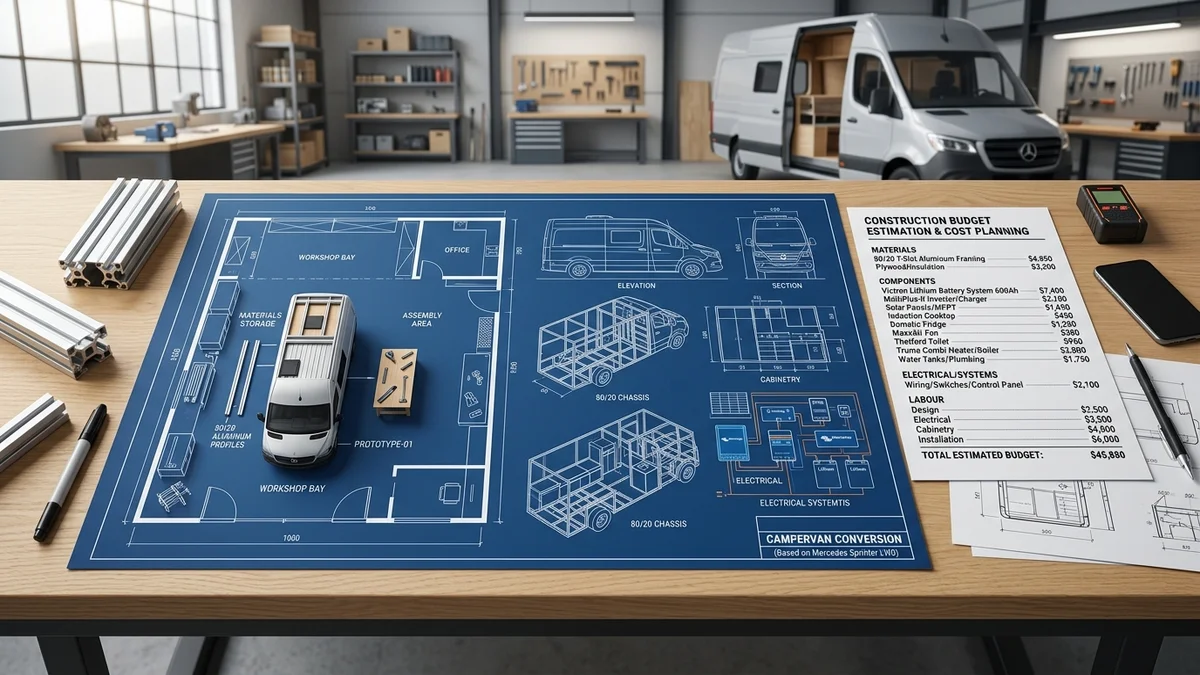
Campervan Conversion Budget and Cost Allocation
Capital allocation matrix across electrical, thermal, fluid, and interior cabinetry subsystems.

1. The "Ghost Budget": The 20% In Fasteners, Consumables & Specialized Tools

The most prevalent pitfall for first-time DIY campervan builders is pricing out only major headline items (the battery bank, fridge, diesel heater, and roof fan) while neglecting the "ghost budget" of installation consumables. Building a durable, rattle-free overland vehicle requires hundreds of small, specialized components that quickly tally between 2,500 USD and 4,500 USD:

  • Structural Fasteners: 1/4-20 and 5/16-18 pre-bulbed steel Plusnuts / Rivnuts, grade 8 bolts, nylon locknuts, and professional heavy-duty pneumatic or lever install tools (350 to 600 USD).
  • Marine Polyurethane Adhesives: 8 to 12 tubes of Sikaflex 252 structural adhesive, 3M 5200 marine sealant, and 3M 90 high-strength contact spray (250 to 400 USD).
  • Heavy Electrical Consumables: Heavy-duty hydraulic lug crimpers, marine dual-wall polyolefin heat shrink with heat-activated glue lining, tinned copper lugs, ANL/Class-T fuse holders, and Blue Sea Systems busbars (600 to 1,200 USD).
  • Sound Deadening: 80 mil butyl vibration dampening sheets (Noico / Kilmat) covering 35% of flat sheet metal resonating panels (250 to 450 USD).

2. 80/20 T-Slot Aluminum Extrusion vs. Plywood Cabinetry: Cost vs. Weight Tradeoff

Two primary construction methodologies dominate modern campervan interiors:

Baltic Birch Plywood (1,500 to 3,500 USD): Traditional carpentry using 1/2" and 3/4" multi-ply Baltic birch. Yields a warm, residential Scandinavian aesthetic. However, wood is vulnerable to seasonal humidity expansion, requires extensive sanding/sealing, and is heavy if over-built with 2x4 framing.

80/20 T-Slot Aluminum Extrusion (3,500 to 7,500 USD): Industrial modular anodized aluminum framing (10-Series or 15-Series). Extrusion offers impervious tensile strength, zero rot/moisture sensitivity, and can be infinitely reconfigured or bolted directly to vehicle chassis Plusnuts without stripping screws over thousands of miles of washboard tracks.

3. Commercial Insurance, Agreed Value Policies & Financing

Standard personal auto insurance (comprehensive/collision) does NOT cover the 30,000+ USD you spend on batteries, lithium inverters, and custom cabinetry in the event of theft or an accident. If a rear-end collision totals your Sprinter, traditional insurance companies payout only the base KBB value of an empty cargo van.

To protect your investment:

  1. Transition Title to Motorhome (RV): Meet your state DMV requirements (typically requiring at least 4 of 6: cooking appliance, refrigeration, toilet facility, 120V electrical system, heating/air conditioning, water supply).
  2. Agreed Value Specialty Policy: Obtain an Agreed Value policy from specialized underwriters (such as Roamly, Progressive, or State Farm).
  3. Maintain a Certified Paper Trail: Keep an itemized spreadsheet of all receipts, high-resolution wiring harness photos before closing wall panels, and a certified scale slip from a commercial CAT scale.
Budget FAQ

Frequently Asked Campervan Budget & Cost Questions

Verified financial calculations for conversion costs, resale value retention, and hidden hardware expenses.

01 How much does it really cost to convert a van into a campervan?

A functional DIY conversion typically costs between $8,000 and $15,000 for a budget build (basic 12V AGM/lithium, Chinese diesel heater, 2x4 wood framing, and portable water jugs). A high-reliability mid-tier build (Victron 400Ah LiFePO4, 3M Thinsulate, 80/20 aluminum or Baltic birch cabinetry, and indoor shower) averages $22,000 to $38,000 in materials. Turnkey professional builds from certified upfitters range from $65,000 to $140,000+ (excluding the base chassis vehicle).

02 What is the single most expensive subsystem in a van build?

The electrical system is consistently the most expensive component, accounting for 30% to 45% of total conversion material expenses. A premium 12V/24V Victron Energy setup (smart lithium batteries, 3000W multiplus inverter/charger, DC-DC alternator charger, MPPT controllers, catastrophic Class-T fusing, and heavy copper wiring) easily totals $6,000 to $12,000 in raw components alone.

03 How many hours of labor does a DIY van build require?

An inexperienced first-time builder typically invests 600 to 1,000 hours of labor over 6 to 12 months. Experienced carpenters or mechanics can complete a mid-tier build in 300 to 450 hours. Sourcing components, reading wiring diagrams, and correcting fabrication errors consume roughly 35% of that time.

04 Do converted campervans hold their value upon resale?

Vans built with certified marine/RV components (Victron, Webasto, 3M Thinsulate, 80/20 aluminum) and backed by detailed electrical single-line schematics retain 65% to 80% of their material investment over 3 to 5 years. Rigs built with shoddy household Romex wire, unverified batteries, or heavy 2x4 framing suffer steep 50%+ depreciation.