Campervan Heating Dynamics: Conductive Loss, Moisture Chemistry & Error Diagnostics
Maintaining safe, dry thermal equilibrium in a sub-zero campervan requires an understanding of building envelope thermodynamics, unvented combustion moisture chemistry, and diesel heater glow plug ignition mechanics.
1. Thermodynamic Heat Loss Formulation: Conductive & Infiltration Losses
Heat transfer through a campervan's chassis occurs through two primary mechanisms: conductive transmission through the insulated composite envelope and convective infiltration from ventilation air exchanges. Total steady-state thermal loss Q_total (in BTU/hr) is derived from Fourier's Law of thermal conduction:
Q_conductive = ∑ [ (A_i / R_i) × (T_inside - T_outside) ] Where A_i is surface area in square feet (ceiling, walls, floor, and glass), R_i is the thermal resistance rating (ft²·°F·hr/BTU), and ΔT is the design temperature differential.
In a high-roof van (approximately 500 sq ft of total external envelope with 20 sq ft of single-pane glass), failing to install thermal reflective window covers reduces overall effective thermal resistance by 35%. Additionally, fresh air ventilation (mandated at 0.5 air changes per hour for carbon monoxide safety) adds convective heat load:
Q_ventilation = Volume (cu ft) × ACH × 0.018 × ΔT Applying a 20% engineering safety buffer accounts for door openings, cold thermal bridges across structural steel ribs, and wind chill convection across the exterior metal skin.
2. The Moisture Physics of Unvented Propane (Mr. Heater Buddy)
Many budget campervan builders start with portable catalytic or ceramic propane heaters like the Mr. Heater Buddy. While convenient, burning unvented propane inside an enclosed living capsule introduces catastrophic levels of water vapor through hydrocarbon combustion chemistry:
C_3H_8 (Propane) + 5 O_2 → 3 CO_2 + 4 H_2O (Water Vapor) + Heat For every 1.0 lb (453 grams) of propane consumed, the combustion reaction releases exactly 1.64 lbs (0.74 kg) of water vapor directly into the interior cabin air. Over an 8-hour winter night, burning a standard 1 lb disposable cylinder pumps nearly 1 quart of liquid water into the air.
In cold weather, this airborne water vapor immediately condenses on cold steel van walls, soaking behind tongue-and-groove cedar paneling and inside fiberglass insulation. This moisture creates hidden black mold (Stachybotrys chartarum), accelerates chassis rust, and reduces the insulation's thermal R-value by up to 50%.
3. Oxygen Depletion Sensor (ODS) and High-Altitude Flameout
Portable catalytic heaters incorporate an Oxygen Depletion Sensor (ODS) that shuts off gas flow if ambient oxygen drops below 18.0% (normal atmospheric concentration is 20.9%).
However, at elevations exceeding 5,000 to 7,000 feet (such as Colorado mountain passes or high-desert BLM land), reduced atmospheric barometric pressure lowers the partial pressure of oxygen (pO&sub2;). The ODS pilot flame cannot generate sufficient thermal voltage across the thermocouple (which requires at least 18–24 millivolts to hold the safety magnet valve open), causing recurring nuisance shutdowns even when actual air oxygen levels are safe.
4. Dry Forced-Air Diesel Heaters: Architecture & Fault Code Matrix
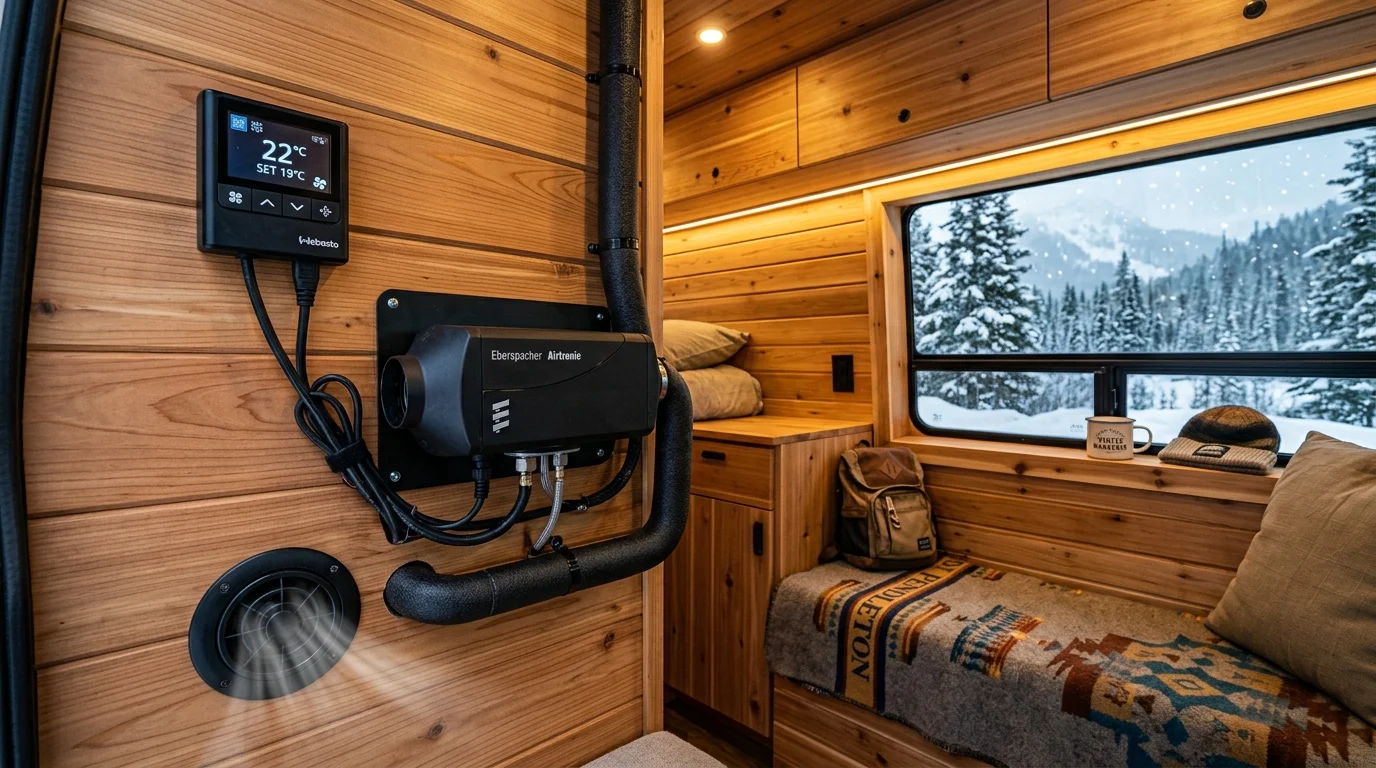
Dedicated 12V diesel air heaters (Webasto Air Top 2000 STC, Espar / Eberspächer Airtronic S2, and generic Chinese diesel heaters) resolve the moisture crisis by employing a sealed, closed-loop combustion chamber. Outside combustion air is drawn in, mixed with atomized fuel, burned, and vented directly beneath the vehicle floor. Clean cabin air circulates around the exterior cast-aluminum heat exchanger fins with 0% moisture transfer into living spaces.
| Diagnostic Code | Fault Condition | Primary Root Cause | Remediation Protocol |
|---|---|---|---|
| E-01 / F01 | Undervoltage Trip (< 10.5V) | Glow plug draws 10A-13A startup surge through thin wiring | Upgrade power harness to 10 AWG; check battery terminal torque |
| E-02 / F02 | Overvoltage Trip (> 16.0V) | Lithium alternator surge or faulty charge controller | Verify solar charge profile does not exceed 14.6V |
| E-03 / F03 | Glow Plug Malfunction | Open circuit or excessive carbon buildup on ceramic element | Test resistance (0.6–1.2 Ω); clean screen atomizer mesh |
| E-04 / F04 | Fuel Pump Open/Short | Damaged solenoid coil or pinched wiring harness | Check 12V pulse signal; verify pump angle is 15°–35° upward |
| E-05 / F05 | Overheating Sensor (> 250°C) | Crushed ducting, restricted intake airflow, or bad blower | Clear flexible duct obstructions; maintain > 12" air clearance |
| E-08 / F08 | Extinction / Flameout | Fuel starvation, air bubbles in fuel line, or sooted burner | Purge air from line; ensure hard nylon fuel line (not soft rubber) |
When installing diesel fuel delivery lines, always use rigid nylon micro-bore tubing (1.5mm inner diameter) rather than soft rubber fuel hose. Soft rubber pulses with every stroke of the solenoid pump, absorbing hydraulic pressure and causing inconsistent fuel delivery that triggers chronic E-08 flameout errors.