
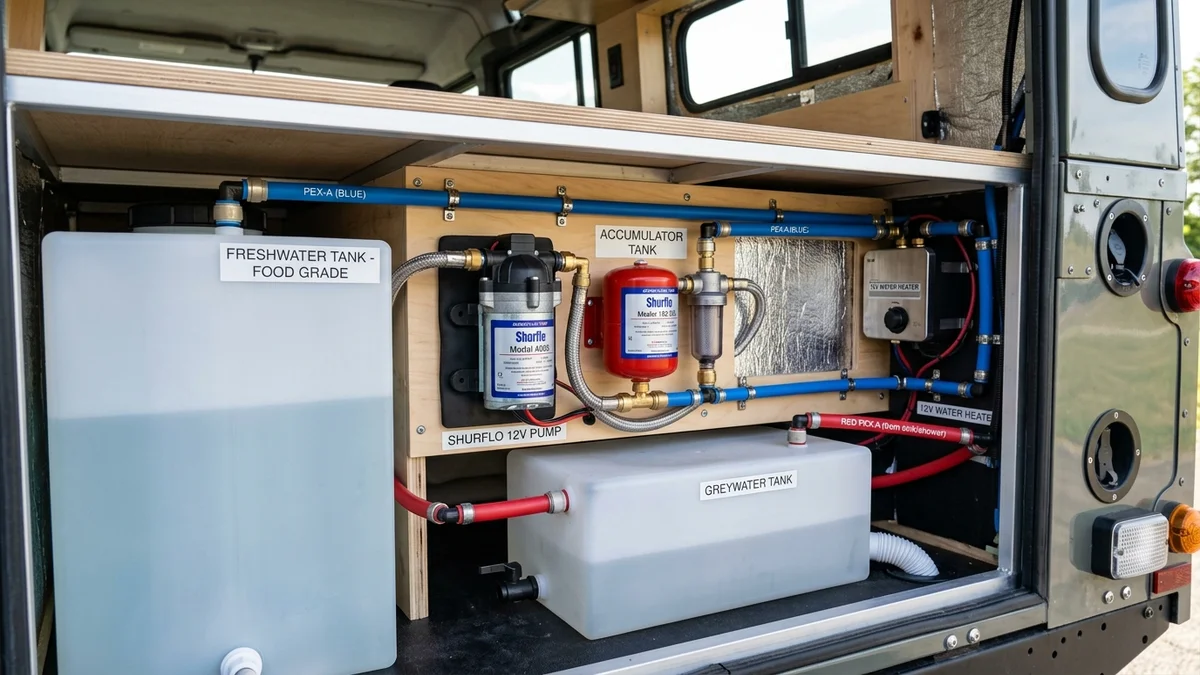
1. Calculating True Daily Off-Grid Water Consumption
Water management in a mobile campervan represents a strict mass-energy balance. Unlike a residential home with municipal connection, every gallon carried represents 8.34 pounds (3.78 kg) of dynamic weight against your chassis Gross Vehicle Weight Rating (GVWR), and every gallon discharged must be legally stored in a sanitary grey water holding tank.
Field empirical data from over 500 overland expedition rigs reveals three primary consumer profiles:
- The Weekend Minimalist (1.2 to 2.0 gal/person/day): Utilizes water purely for hydration, AeroPress coffee, brushing teeth, and minimal dishwashing using spray bottles. No onboard shower.
- The Remote Digital Nomad (3.0 to 4.5 gal/person/day): Full daily lifestyle including morning coffee, cooking lunch/dinner, thorough dishwashing, and an onboard navy shower every other day.
- The Luxury Expedition Traveler (6.0 to 8.0 gal/person/day): Includes daily warm high-pressure showers, indoor galley cooking, and gravity flush sanitation. Requires 40+ gallon fresh storage and frequent fill intervals.
2. 12V Diaphragm Pumps vs. Submersible Pumps: Flow Rates & Noise Isolation
The heart of any mobile water system is the 12V positive-displacement diaphragm pump (such as the industry-standard Shurflo Revolution 4008 or Seaflo 42-Series). Diaphragm pumps are self-priming, can run dry without catastrophic seal failure, and feature built-in pressure shut-off switches (typically factory calibrated between 45 and 55 PSI).
However, positive-displacement pumps generate severe mechanical vibrations. Without proper isolation, the pulsing diaphragm transforms your van's plywood cabinetry into a giant acoustic sounding board. To achieve silent operation:
- Mount on Flexible Rubber Isolation Feet: Never screw the pump directly to structural metal ribs or thin plywood panels.
- Install Flexible Braided Silencer Loops: Transition from the pump inlet/outlet with minimum 18 inches of flexible food-grade reinforced braided hose before coupling into rigid PEX-A lines. This eliminates hydraulic hammer.
- Pre-Pressurized Accumulator Tank: Install a 1.0-liter accumulator tank pre-charged to 30 PSI (3 PSI below pump cut-in pressure). This allows low-flow trickles without rapid pump cycling.
3. PEX-A (Expansion) vs. PEX-B (Crimp) in Mobile Living Environments
When plumbing a campervan, PEX-A (Uponor ProPEX) is vastly superior to copper, CPVC, and standard hardware-store PEX-B crimp rings. PEX-A utilizes cross-linked polyethylene with thermal shape memory. It expands over barbed fittings using a mechanical expansion tool and contracts, creating an impervious 150 PSI seal with zero O-rings that could vibrate loose over washboard gravel roads.
Crucially, PEX-A can expand up to 300% of its nominal diameter without bursting if trapped water freezes solid, whereas rigid PEX-B fittings and copper lines routinely crack at the brass joints during unexpected alpine cold snaps.
4. Winterization Protocol & Sub-Zero Tank Location Strategies
The single most common catastrophic winter failure in campervans is frozen plumbing lines and cracked water pump filter housings. To safeguard your system down to -10°F (-23°C):
- Interior Tank Placement: Mount fresh water tanks strictly inside the conditioned living space—typically over the rear wheel wells or beneath the garage bed platform. The interior ambient heat from your diesel or propane air heater will prevent the water mass from freezing.
- External Tank Dual Protection: If mounting a grey water tank externally under the chassis floor, insulate the tank with 1/2" closed-cell foam and install an automated 12V UltraHeat silicone heating pad with an internal thermostat that activates at 40°F (4°C).
- Gravity Low-Point Drains: Plumb mechanical 1/4-turn ball valves at the absolute lowest point of your PEX lines passing through the floor, enabling complete gravity drainage in 60 seconds before storing the vehicle in winter.